How to Make Money From Music: 10+ Ways to Get Paid (2026)
There is no single income stream in music that reliably pays an independent artist a living. There are seven that pay something, and the artists who sustain a career combine four or five of them. This guide covers what each one actually pays, how long you wait for the money, and where the effort is best spent.
One of the quickest to set up is sync licensing: you can list your tracks on Melody so brands can license them for their videos. You set the price and keep 75% of every licence.
The streaming maths, honestly
Start with the number everyone quotes. Major streaming services pay roughly $0.003 to $0.005 per stream into the rights-holder pot. The precise rate is not a fixed price per play — it is a share of subscription and advertising revenue divided across all listening on the service, so it moves with listener country, subscription tier and total plays that month. Spotify publishes its own explanation of how this works at Loud & Clear, which is worth reading before you accept any per-stream figure as fixed.
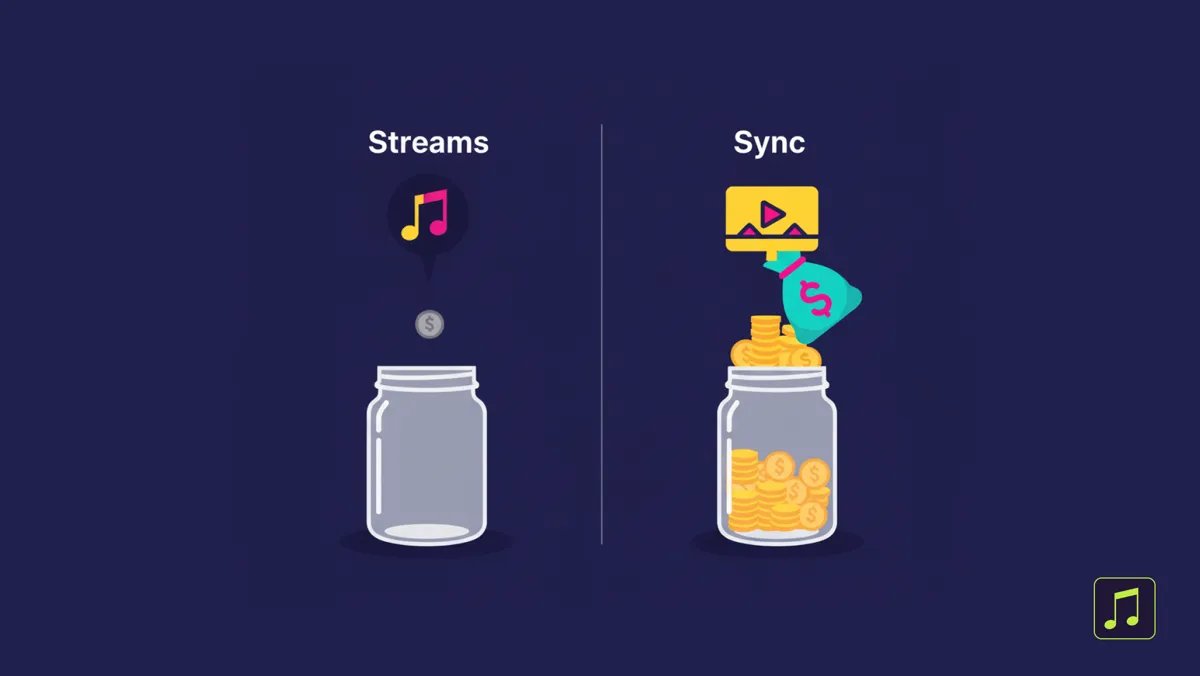
Run that rate forward and the picture is stark. One million streams generates roughly $3,000–$5,000 gross. That is before your distributor's cut, before co-writers, before a label share if you have one. To clear a UK or US full-time salary from streaming alone you are looking at millions of plays every year, sustained. The vast majority of released tracks never approach that — most never pass a few thousand plays at all.
The correct conclusion is not that streaming is worthless. It is that streaming is a discovery and long-tail layer, not a salary. It makes your catalogue findable, credible and licensable. The income comes from what you build on top of it. If you are still early, our guide to getting your first 1,000 streams covers the groundwork.
The seven streams at a glance
| Stream | Typical pay | Effort | Speed | Ceiling |
|---|---|---|---|---|
| Streaming royalties | $0.003–$0.005 per stream | High volume needed | 60–90 days, via distributor | Low per track, scales only with audience |
| Sync licensing | $5–$50,000+ per placement | Catalogue prep, then passive | On licence, days to weeks | High — one placement can beat a year of streams |
| Direct-to-fan sales | 70–90% of sale price | Needs an existing audience | Immediate to monthly | Medium, capped by fanbase size |
| Live performance | Door split, guarantee or fee | Very high, travel and time | Same night to 30 days | High, but costs scale with it |
| Merchandise | 40–60% margin after production | Medium, inventory and design | Immediate | Medium, strongest at shows |
| Publishing / PRO income | Performance and mechanical royalties | One-off registration, then passive | Slow — often 6–24 months in arrears | Medium, compounds with usage |
| Session and production work | Hourly or per-track fee | High, trades time for money | On invoice | Medium, capped by your hours |
1. Sync licensing
Sync licensing means granting permission to synchronise your recording with visual media — an advert, a TV episode, a film, a game, a brand's social campaign. It is the stream with the highest value per transaction available to an independent artist without a team, and it is the one most artists under-use.
What does it pay? On Melody, where prices are set by the rights holder and shown publicly, the median licence is $25 and the mean is around $131 — the gap between those two numbers tells you the distribution is lopsided. Roughly 42% of the catalogue sits in the $5–$10 band for social and creator use, while about 34% is priced at $100 or above for commercial campaigns. We published the full breakdown, including how those prices are distributed by genre, in the State of Sync 2026 study.
Those are marketplace figures for self-serve licensing, and they are deliberately accessible. Negotiated sync — a national TV campaign, a film placement, a game trailer — operates at an entirely different level, commonly four or five figures per placement, sometimes far more. Our breakdown of what sync licences cost walks through the bands and the six factors that move a fee.
Compare a single $100 marketplace licence against streaming: you would need somewhere in the region of 20,000 to 33,000 plays to gross the same amount, and you would wait a quarter for it. The sync fee lands on the licence.
The practical work is preparation, not hustle. Instrumental and clean versions ready, metadata correct, rights unambiguous, no uncleared samples. Our sync checklist covers exactly what a supervisor or brand needs before they can say yes, and how to get your music in ads covers the routes in. If you are weighing where to spend your energy, sync versus playlist pitching compares the two directly.
2. Publishing and PRO royalties
This is the stream most independent artists leave uncollected. Your composition — as distinct from your recording — earns performance royalties whenever it is played publicly: radio, TV, live venues, streaming, shops and bars. Collecting requires you to be registered with a performing rights organisation such as PRS for Music in the UK, or ASCAP or BMI in the US, and to register each work.
It is slow money. Performance royalties often arrive six to twenty-four months after the usage, and statements are famously opaque. But it is genuinely passive once the registration exists, and it compounds: a track placed in an advert earns its sync fee once, then keeps earning performance royalties every time that advert airs. Artists who skip registration are giving that second payment away.
3. Direct-to-fan sales
Selling music directly — through Bandcamp, your own site, or physically at shows — inverts the streaming economics. Instead of fractions of a cent per play, you keep the large majority of a real purchase price. One engaged fan buying a $10 record is worth thousands of streams.
The constraint is obvious: this scales with the size and warmth of your audience, not with reach. A thousand passive listeners generate almost no direct sales; a hundred committed ones generate real money. Direct sales are best understood as the monetisation layer for an audience you already have, which is why they pair naturally with live work and mailing lists rather than with algorithmic playlists.
4. Live performance
Live remains the largest income source for a substantial share of working musicians, and the most variable. Early on it is door splits and small guarantees that barely cover travel. Established acts negotiate fees that dwarf every other stream on this list.
Treat it as a business with costs, because it is one — transport, accommodation, equipment, commission, and your time. A well-paid show that costs more to reach than it pays is a loss dressed as a win. The reliable strategy is to build density locally before expanding geographically: a room you can fill in your own city is worth more than five half-empty rooms across a region.
5. Merchandise
Merch margins are strong — typically 40–60% after production — and the best-converting moment to sell is immediately after a live performance, when intent is at its peak. Print-on-demand removes the inventory risk at the cost of some margin, which is usually the right trade until you know what sells.
Merch also does something the other streams do not: it makes fans visible. Someone wearing your shirt is marketing you for free, indefinitely.
6. Session work and production
Playing on other people's records, producing, mixing, or writing to brief converts your existing skill into predictable fees. It is active income — you stop, it stops — so it will not compound. But it pays promptly, it is far less dependent on your own audience, and it builds the network that later generates sync and collaboration opportunities.
For most developing artists this is the stream that pays the rent while the passive streams are still being built.
7. Teaching and memberships
Lessons, courses, sample packs and membership platforms monetise expertise rather than catalogue. Recurring memberships in particular provide something almost nothing else in music does: predictable monthly income you can plan around. The trade-off is that they demand consistent output for subscribers, which is a real ongoing commitment rather than a passive stream.
How to combine them
A workable portfolio has three layers. Active income — session work, teaching, live — covers your costs now. Asset income — sync licences, direct sales, merch — pays irregularly but at meaningful amounts per event. Compounding income — publishing royalties, catalogue streaming — starts near zero and grows for years without further work, provided you registered properly.
The common failure is to build only the first layer, stay permanently busy, and own nothing that pays while you sleep. The second most common is to build only the third, wait for royalties that never reach a living, and run out of money first. Deliberately spending some of this quarter's active income on building next year's asset and compounding income is the whole game.
If you have released music already, the fastest asset-layer move available to you is making that catalogue licensable. It costs nothing, it is non-exclusive, and the tracks keep working everywhere else.
Make your catalogue licensable
Submit your released tracks to Melody, set your own price, and keep 75% of every sync fee. Non-exclusive — your music stays everywhere else it already is.
Frequently asked questions
How much do artists make per stream?
Most major streaming services pay somewhere in the region of $0.003 to $0.005 per stream to the rights holders, though the exact figure varies by service, listener country and subscription type. That is the amount paid into the pot before your distributor, label or co-writers take their share, so what actually lands in your account is usually lower.
How much is 1 million Spotify streams worth?
At $0.003–$0.005 per stream, one million streams generates roughly $3,000–$5,000 in gross royalties. That is split between everyone with a claim on the recording and the composition. An unsigned artist distributing through a flat-fee distributor keeps most of it; an artist on a standard label deal may see a fraction.
Can you make a living from music?
Yes, but almost never from a single stream of income. The artists who sustain it typically combine several sources — some passive (sync, publishing, catalogue royalties) and some active (live, teaching, session work). Treating it as a portfolio rather than a search for one breakthrough is the practical difference.
Is sync licensing more profitable than streaming?
Per transaction, yes, by a wide margin. On Melody the median licence is $25 and roughly a third of licences are $100 or more. Matching a single $100 licence through streaming alone would take somewhere around 20,000–33,000 plays. Streaming still matters for discovery and long-tail income, but the per-event value is not comparable.
How do I get paid for sync licensing?
On a marketplace like Melody the brand licenses the track at a listed price and the rights holder receives 75% of the fee, paid out through their connected payout account. Elsewhere, sync fees are negotiated per placement and paid on signature or on broadcast, often split between the master owner and the publisher.
Do I need a label to earn money from music?
No. Distribution, sync licensing, publishing registration and direct sales are all available to independent artists directly. A label buys you capital, staff and relationships in exchange for a share of your income — useful at certain scales, unnecessary at others.

About the Author
Samuel Olsson is the Head of Growth at Melody and the Managing Director of Kurve, an award-winning growth marketing agency. With over a decade of experience building scalable growth engines for tech companies, Samuel is now focused on solving the biggest problem in music: connecting the 90% of unheard artists with the brands that need their sound.
View full profile →Related Reading
Sync vs Playlists: Which Path Makes More Money?
Compare sync licensing and playlist pitching to understand which revenue stream actually pays indie artists.
How to Get Your Music in Ads
Learn the step-by-step process to get your tracks licensed for advertising.
How Much Does a Sync License Cost?
Real price bands for social, digital, TV and film — and the six factors that move the fee.
The Sync License Checklist
Prepare your tracks for professional licensing opportunities.